












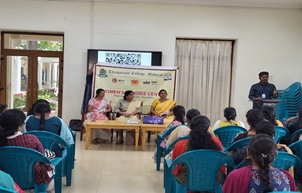
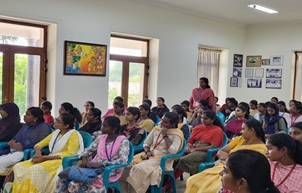
The Women’s Studies Centre organized an awareness programme titled “Fuel Your Life: Smart Nutrition for the Stronger You”. The resource person was Dt. S. Sivapakkiyam, M.Sc. Food Science and Nutrition, Senior Consultant, Healthifyme Wellness Ltd. The programme was aligned with Sustainable Development Goal 3 – Good Health and Well-Being, promoting health awareness and inspiring students to adopt a balanced lifestyle for a stronger, healthier future.Dr. R. Aruna, Director, WSC, welcomed the gathering and spoke about the importance of prioritizing health in today’s generation.
The session began with an overview of balanced nutrition and its role in maintaining overall well-being. The speaker explained the functions of carbohydrates as the body’s primary energy source, distinguishing between simple sugars, complex starches, and dietary fibre. The significance of proteins in muscle repair and satiety, along with healthy fats for vitamin absorption and energy, was also discussed.
The lecture highlighted vitamins and minerals as crucial micronutrients. Fat-soluble vitamins (A, D, E, K) and water-soluble vitamins (C and B-complex) were explained with their benefits in immunity, growth, bone health, and metabolism. Minerals such as calcium, magnesium, and iron were presented as essential for development, nerve function, and blood health. Fiber was described as vital for digestion, gut regulation, and cardiovascular health. For each nutrient, the resource person suggested suitable fruits and vegetables that can be included in the daily diet.
The importance of water was emphasized as an irreplaceable component of daily intake, supporting hydration, nutrient transport, temperature regulation, and skin health. Students were guided on consuming 2–3 litres per day through water, fruits, vegetables, and healthy fluids. Practical advice was given using the “plate method,” dividing meals into vegetables, fruits, proteins, whole grains, and small portions of healthy fats, while limiting fried and processed foods.
After the lecture, the Question and Answer session addressed student concerns such as structuring their meal plate, handling morning and night cravings, and managing junk food habits. Questions on symptoms, a no-sugar diet, and nutrition-related deficiencies were discussed. The resource person suggested practical alternatives for cravings and explained how certain deficiencies could lead to specific food desires.
The event concluded with a vote of thanks by Dr. C. Usha, Programme Coordinator, Gender Studies, who encouraged students to take the insights as a meaningful takeaway and practice them in daily life for long-term health and well-being.

