












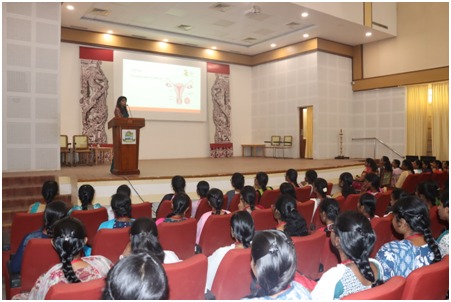
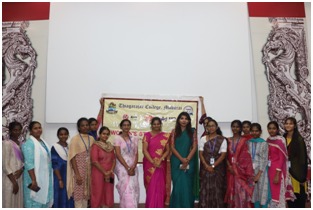
The Women’s Studies Centre of Thiagarajar College, Madurai – 09, organized an Awareness Lecture on “Causes of Cervical Cancer and the Role of HPV” on 07th January 2026, in commemoration of Cervical Cancer Awareness Month, in alignment with Sustainable Development Goal – 3 (Good Health and Well-being). The programme aimed to create awareness among students about cervical cancer, its risk factors, prevention, and the importance of early screening.
The programme commenced with a welcome address by Dr. R. Aruna, Director, Women’s Studies Centre, who warmly welcomed the dignitaries, resource person, faculty members, and students. She highlighted the importance of women’s health awareness, early detection, and preventive care, emphasizing the relevance of organizing such programmes to promote informed and healthy lifestyles among young women.
The programme featured Dr. Mythily Prathibha, MBBS., DNB (O&G)., DRM., FMAS., Consultant – Obstetrics & Reproductive Medicine, Rio Children’s Hospital, Madurai, as the resource person. She began the session by explaining cervical cancer as a malignancy affecting the lower part of the uterus (cervix) and emphasized that Human Papilloma Virus (HPV) is the primary causative factor.
During the lecture, the resource person elaborated on the risk factors associated with cervical cancer, including early onset of sexual activity, multiple sexual partners, having a partner with high-risk behavior, smoking, prolonged use of contraceptive pills, low socio-economic status, and multiple pregnancies. She highlighted that the disease is often non-specific in its early stages, leading many patients to seek medical attention only at an advanced stage.
Dr. Mythily Prathibha stressed the significance of Pap Smear screening, stating that it is an effective and affordable test that can reduce the incidence of cervical cancer by nearly 80%. She explained that the test is simple, takes hardly two minutes, and is recommended for married women aged 30 to 65 years, once every three years, and every five years when combined with HPV testing.
The session also focused on HPV vaccination as a key preventive measure. The ideal age for vaccination was highlighted as 9 to 14 years, preferably before the onset of sexual activity. The resource person further informed that vaccination can be administered up to 45 years of age. Details regarding vaccination schedules were explained, including Cervarix (0, 1, and 6 months) and Gardasil (0, 2, and 6 months). She emphasized that even vaccinated individuals must continue regular Pap Smear screening every three years.
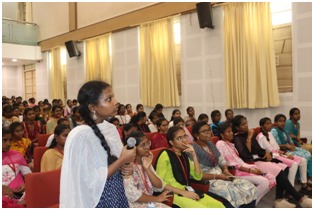
The lecture was highly informative and interactive, enabling participants to clarify their doubts regarding screening, vaccination, and preventive healthcare practices. The session helped students understand the importance of early detection, regular screening, and adopting a healthy lifestyle to prevent cervical cancer.
The programme concluded with a vote of thanks proposed by Ms. Veena Vidhya Sri, Assistant Professor, Department of Psychology, who expressed gratitude to the resource person, organizers, and participants for their valuable contributions and active participation, which ensured the success of the programme.

